In October 1998 I was a 25-year-old graduate with no ties and very few worries in life. I loved travelling and partying in equal measure, and I had just moved to London when I fell down a flight of stairs and broke my neck. From that moment I was paralyzed from the armpits down and my life changed completely.
The early days were all high drama and tragedy involving two weeks of intensive care wards at a London hospital, torturous breathing equipment and a lot of morphine. I was then moved to the National Spinal Injuries Unit at Stoke Mandeville Hospital where I was told without much pomp or ceremony that I would probably never walk again, would only have partial use of my arms, must use a wheelchair to get around and would undergo a lengthy rehabilitation before I could go back out into the world. It was devastating at the time.
In the spinal unit, there was a supportive atmosphere amongst the patients of a similar age, and we helped each other through with black humour and cups of tea. Regular visits from Spinal Injuries Association peer support workers who were working, driving, parenting and generally living daily life as wheelchair users, gave me a huge amount of hope for the future. After the best part of a year, I was ready to leave hospital equipped with all the skills needed to navigate the world as a disabled person, but it was only when I left the hospital environment that I really discovered what it was like to be disabled.
It felt as if my status in society had plummeted, as if because I was physically different people viewed me differently and treated me accordingly. Conversations would happen over my head; shop counters were too high and the people serving would talk to the person with me instead of me directly. It was emotionally draining and completely exhausting. In addition, it felt as if ‘the system’ was hugely complicated: trying to access the best wheelchair for my needs without it costing the price of a second hand car, trying to find somewhere to live with wheelchair access and then waiting for housing adaptations or essential pieces of equipment. The system had to be negotiated before I could move back into employment and become a productive member of society.
I did an MA in Applied Sociology and discovered the Social Model of Disability. I found it so empowering, and it was just what I needed to navigate the world from then on. After graduating I worked for a charitable organisation as a disability equality trainer and access auditor – facilitating workshops in disability issues, the DDA and later the Equality Act. I spent a lot of time measuring doorways and the height of toilets and advising businesses and services how to make their facilities more accessible. It felt as if I was doing important work, which was far more fulfilling than anything I had done before breaking my neck. Despite this, a family member once patted me on the shoulder and said ‘it’s good to hear you’re getting out’ when I told him what I did for a living, as if my job was of little value.
My husband has always had the fantastic ability to boost my confidence by seeing me as the same human I’ve always been with things to achieve in life. Since having our daughter, we are now a family of three and tend to do the same things as other families, even if it takes extra planning. We are yet to find a hotel with an accessible family room – the assumption seems to be that people can be parents or wheelchair users, but not both. Despite the access issues, we have travelled the world, visited many museums, been to concerts, countless over-stimulating soft plays and in the process managed to grow a well-adjusted human who has left home for a university far away from her over needy parents.
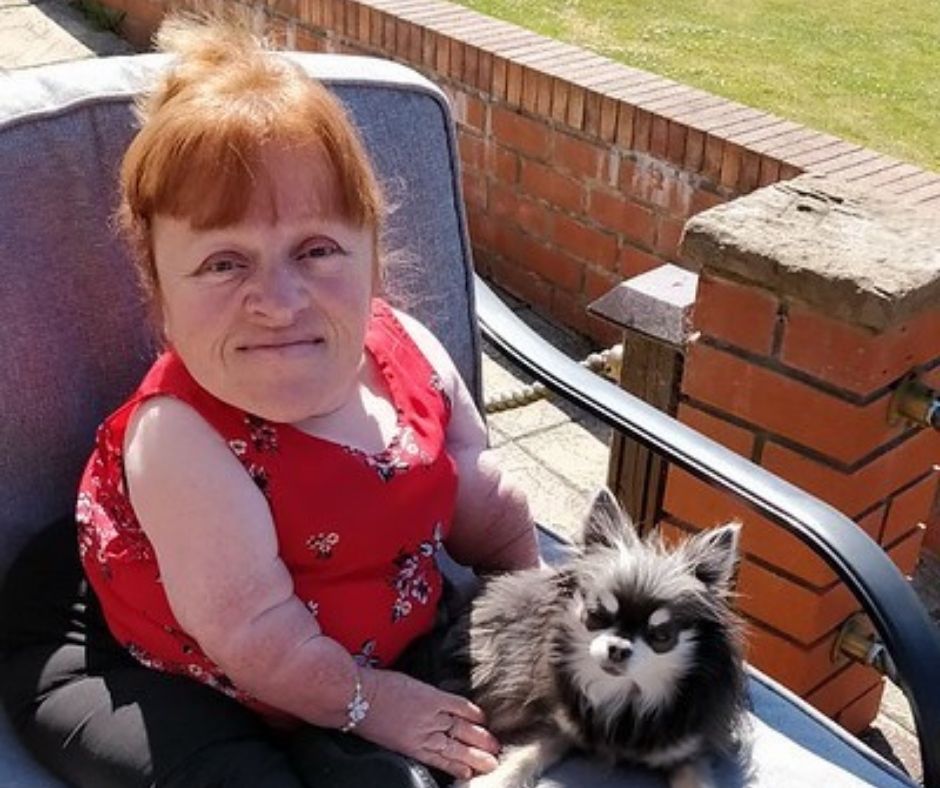
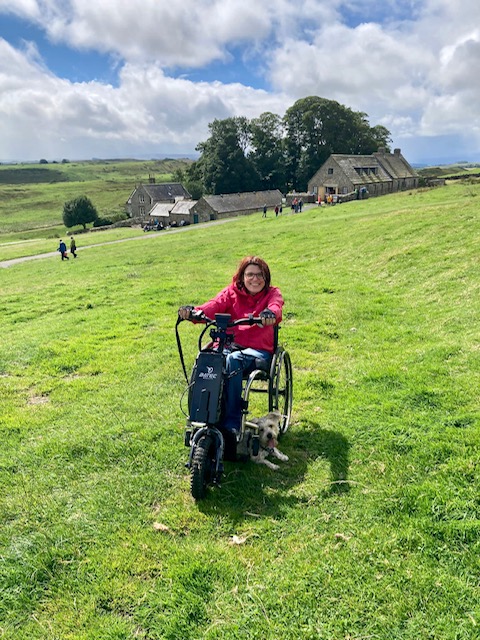
I’ve now been disabled for longer than I was non-disabled and my daughter knows me no other way. In that time, I’ve been a student, an employee, a hands on parent and small business owner. In recent years, I’ve really embraced electric add-ons for manual wheelchairs – they have opened up my world and taken me to places I thought were off limits until now, such as Northumbrian beaches and Hadrian’s Wall. I’m often found having off-road adventures with my tiny little dog and I sometimes post reviews of our accessible dog walks on Instagram, even though my photography skills are terrible!